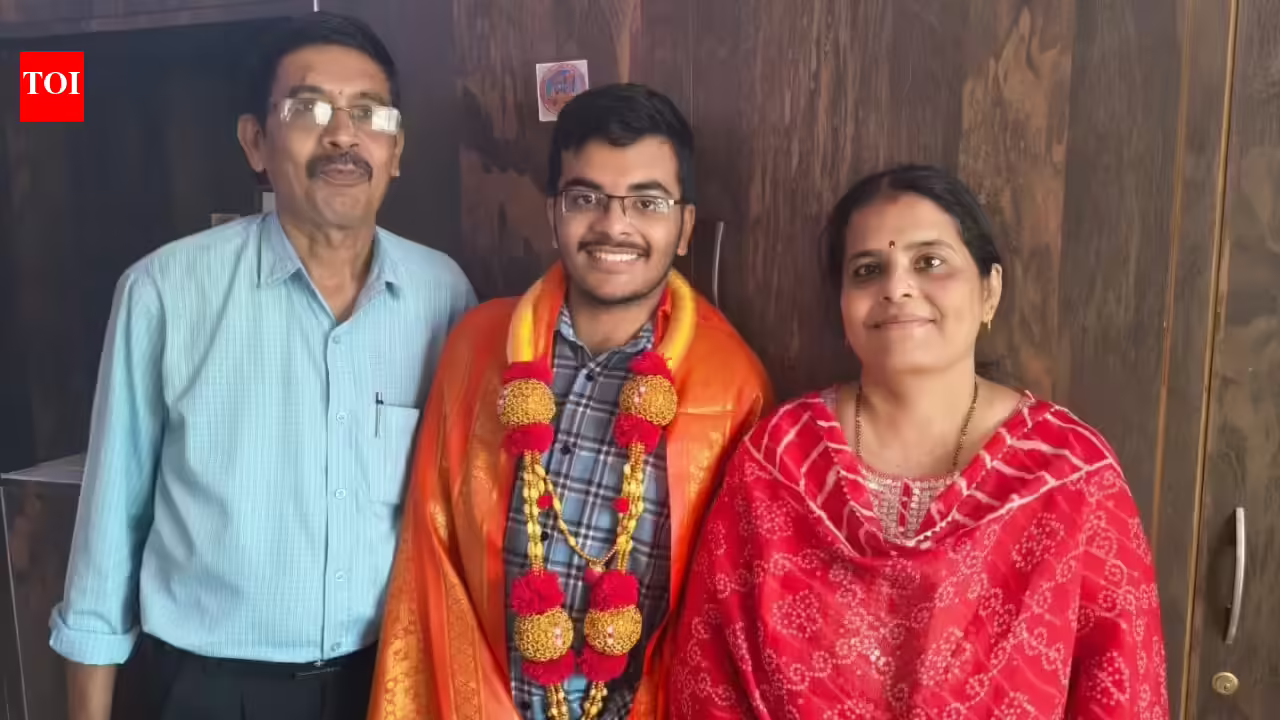
There are exams that end when the paper is submitted. And then there are exams that quietly extend into everyday life in weekly tests, timed practice sheets, and the steady rhythm of preparation that never really pauses.For Srajan BS, who has now secured State Rank 2 in KCET 2026, the result of which was announced on Saturday, pressure was never something that arrived suddenly on exam day. Since Class 6 or 7, he says, he was interested in electronics and understanding how things work. That early curiosity shaped his decision to take up engineering later.“Since around 6th or 7th standard, I was highly interested in electronics and understanding the inner workings of things like mobile phones and other gadgets. I would always try to figure out what was inside them or do something with them. That’s why I felt engineering was right for me.”“My parents were not confident enough to give me working gadgets. They would usually give me broken ones, so I would open them and try to understand how they were built,” he adds with a chuckle.That early habit of observation slowly turned into structured preparation years later, as KCET became one of the key milestones in his academic path. For Srajan, managing KCET alongside Class 12 board preparation was not a separate challenge, but a combined one. Both mattered equally, he says, because KCET ranking considers 50 per cent board marks and 50 per cent CET marks. At Deeksha Vedantu, where he studied, preparation followed a fixed weekly rhythm. “My college conducted weekly tests, for board exams on Fridays and for competitive exams on Mondays,” he says. “This helped me stay on track. Based on results, I could identify my weak areas and improve.” Rather than long study hours, he focused on consistency. “I studied around 3–4 hours daily, every day,” Srajan says. “I followed this from Class 11 and even Class 10. I made sure there were no backlogs.” Along with this routine, he maintained a diary of what he studied each day. Revision was spaced out across days and weeks. “I used to revise after three days, one week, or two weeks,” he says. “Revision is very important because KCET requires quick solving, about a minute per question.” Before the exam, his expectations were modest compared to the final result. “I expected a rank under 500 or 1,000,” he says. “After the exam, I felt I could get under top 10, but I didn’t expect State Rank 2 specifically.” On exam pressure, Srajan describes it as part of the process rather than something separate from it. “Pressure is part of the process,” he says. “It is important to understand pressure and use it positively instead of getting stressed.” “Mindset is very important,” Srajan says advising future aspirants. “Don’t just focus on rank. Have a bigger goal in life. Hard work and consistency are the two most important things. If you follow them properly, you can do well in any exam.”In a year where over 3.3 lakh students registered for the Karnataka Common Entrance Test, Srajan’s 177 out of 180 places him right at the top of a highly competitive list, just behind Tanisha Karthik, who secured Rank 1 in the Engineering stream, and ahead of Ninaad Vasisht at Rank 3. Looking ahead, Srajan is considering mechanical engineering, while also exploring electrical and electronics engineering options.