Jarrod Cecere, Dr. David Calianese, and Scott Bergenfeld at the Biosymposium
For years, David Calianese, Ph.D., assistant professor in Seton Hall’s Department of Biological Sciences, has been
fascinated by the role molecular structure plays in biological function. At the same
time, he recognized how challenging it can be for students to fully grasp these concepts
when complex biological structures are presented as flat images in textbooks or online.
That challenge led Calianese to the Teaching, Learning and Technology Center (TLTC), where he began working with the team to explore new ways to support student learning
across the sciences.
Through discussion, experimentation and close collaboration with Jarrod Cecere, instructional
designer, Scott Bergenfeld, technology trainer and makerspace coordinator and Renee Cicchino, director of instructional design and training, the virtual reality platform Nanome
emerged as a strong fit. Nanome allows students to explore detailed molecular structures in three dimensions
while learning together in a shared virtual environment. Using the TLTC’s Meta Quest
Pro virtual reality headsets offered in the Innovation Hub Exploration Studio, students were immersed in molecular structures, allowing them to examine spatial relationships
and structural features that are difficult to see in static images. The experience
was reinforced through 3D printing, which enabled students to see and physically handle
the same molecular structures they examined in virtual reality.
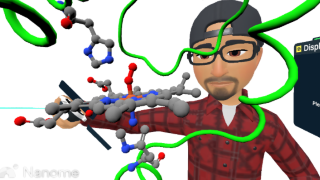
Professor Calianese’s avatar inside a molecule of hemoglobin
During the semester, students in Calianese’s Biochemistry of Metabolism course visited
the Exploration Studio on three occasions, where lectures took place inside Nanome’s
virtual classroom. Calianese, represented by an avatar, highlighted key structural
features in real time while students observed, asked questions and interacted directly
with the models. As Calianese observed, “Regardless of whether they had the VR goggles
on or off, the classroom was buzzing.” Many students continued exploring molecular
structures outside of class using Nanome’s desktop version. According to Calianese,
“This was a completely student-driven project, and it was incredibly rewarding to
see how engaged the undergraduates became.” During their first visit, students also
toured the Maker Studio, where they learned how molecular models are prepared and produced using 3D printers.
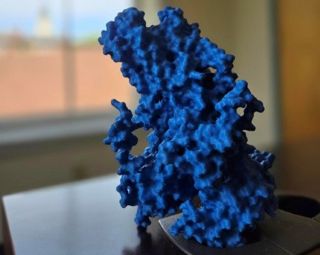
3D-Printed Predicted Protein
For students, the combination of VR exploration and physical models changed how the
material came together. Manipulating molecules in a virtual environment helped make
abstract concepts more intuitive. As student Liam Delahunty explained, “With VR, you
can move the molecule around and manipulate it.” The addition of 3D-printed models
added another dimension to the learning experience. Raven Knopf, also a student in
the course, noted, “Research in the past has been online. With 3D printing, you can
get your hands on the molecule.”
This hands-on exploration ultimately shaped students’ academic work. Groups were assigned
specific molecules to study, including hemoglobin, the protein in red blood cells
that carries oxygen, as well as proteins associated with metabolic disorders such
as diabetes and heart disease. Visual representations of these molecules became the
centerpiece of student presentations at the Biosymposium during the 30th annual Petersheim Academic Exposition.
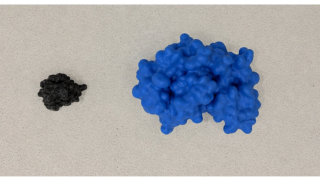
3D-Printed Insulin Molecules
At the exposition, students displayed posters featuring screenshots captured inside
Nanome, including images of their avatars alongside the molecular structures they
studied. They also presented 3D-printed versions of the same molecules. Together,
these visual tools helped students communicate complex scientific concepts to a broad
audience.
Beyond a single course, Calianese’s work reflects broader goals within the sciences
to help students think visually, ask deeper questions and engage with tools used in
contemporary research. His collaboration with the TLTC has also opened opportunities
to expand the assignment in future semesters and explore additional ways students
can work with immersive and emerging technologies.
What began as a course-level project now points to longer-term opportunities for innovation
in science teaching at Seton Hall. Reflecting on the experience, Calianese shared,
“Now is the most exciting time in the history of scientific research and discovery.
Having students use these tools will set them up for long-term success.”
Categories:
Science and Technology