Hold everything. Hollywood’s Lexington Park will not be getting a new playground after all, and that’s both good news and bad news.
To explain, let me take you back to April 15, when I tagged along with Sabine Phillips on her weekly three-hour inspection of the neighborhood’s chronic trash problem. Phillips, a housekeeper by trade, was hired by one of her clients a few years ago to help clean up their streets.
So each Wednesday, Phillips went out on her yellow Huffy cruiser and routinely logged 50 or more illegally dumped items and reported them to the city’s 311 system for pickup. And each Saturday, she filled up to four or five big bags with smaller bits and scraps of debris.
Near the end of my three hours with Phillips, who got help that day from volunteer Keith Johnson, we visited the Lexington pocket park. There were no kids there, and there never are, Phillips said. That’s because of the glass and needles in the sand, drug activity, sporadic violence, gang tags on the slide and homeless camps.
A guy from the Recreation and Parks Department showed up and said the park was in line for a possible upgrade that could cost as much as $300,000. In my April 18 column, I questioned the wisdom of investing in a playground that would remain unsafe unless there was a plan to address all the aforementioned issues.
Nick Barnes-Batista, communications director for L.A. City Councilmember Hugo Soto-Martínez, wrote to tell me his office was unaware of any playground projects planned for that park.
A spokesperson for Recreation and Parks told me that despite what was said by the employee I met in the park, there is no “immediate playground replacement project on the books.” But the department is “working closely” with the councilman’s office “to identify funding sources and to work with the community on broader park improvements and/or uses.”
OK, so it’s good news that taxpayer funds won’t be plowed into a park that could well be lost to the neighborhood almost immediately, due to all the aforementioned problems.
But it’s bad news and sad commentary that a park in the densely populated heart of the city will remain unusable for the foreseeable future.
The more important consideration, though, is the question of what’s being done to prevent the illegal dumping of furniture, mattresses and other items that sit curbside and often end up as the building blocks of new homeless encampments.
There’s a concentration of social service agencies in the neighborhood, said Stefanie Keenan, a longtime neighborhood volunteer and activist. She’s the one who hired her housekeeper to help look after the neighborhood, and she insists there is not enough enforcement of existing laws to address problems that are both a nuisance and a public safety threat, given the crime and all-too-frequent fires.

A woman pushes her walker past debris in Council District 13 in Los Angeles on Friday.
(Genaro Molina / Los Angeles Times)
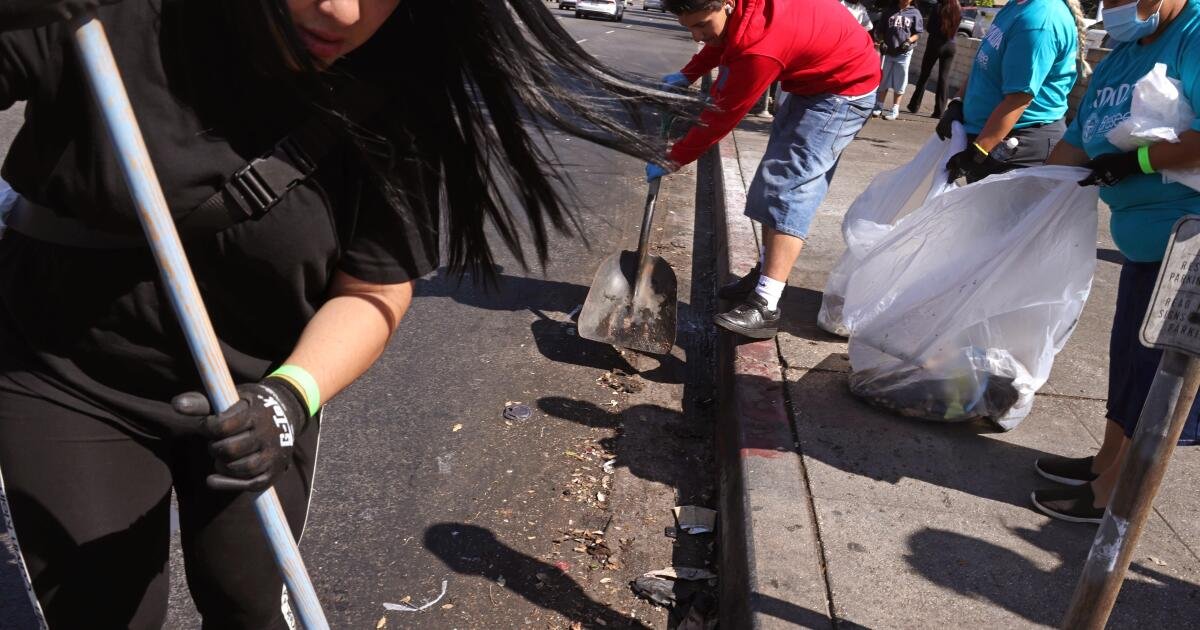
Soto-Martínez agreed to talk to me about all of this on Friday morning, when he dropped by the Bresee Foundation, a nonprofit with a range of enrichment activities for youngsters and families in the largely low-income immigrant community, as well as homelessness prevention programs. Staff and volunteers, recruited with support from the council office, were about to head into nearby streets with shovels, brooms and trash bags.
Soto-Martínez acknowledged his district’s many challenges, told the gathering that the strength of a community is its people, and thanked them for their service.
The councilman, a former labor leader who joined the growing progressive wing of the L.A. City Council in 2022 with support from the local chapter of Democratic Socialists of America, has three challengers in the June 2 primary (Colter Carlisle, Dylan Kendall and Rich Sarian). He told me the city has to do a better job of educating people about illegal dumping and how to report it. A related challenge, he said, “is how quickly can we get to it. And that is a budget issue because we’ve cut so many positions on trash pickup.”
Soto-Martínez said his office used discretionary funds to hire two crews from the L.A. Conservation Corps for trash pickup. On homelessness, he said, he has a team strategizing to address the needs, and a medical team that works the streets, and a tiny home village is in the works.
But the housing shortage is a major challenge, he said, and when it comes to entrenched homelessness, “we’re now starting to deal with much more difficult cases.” Namely severe mental illness and serious addiction, both of which generally come under county jurisdiction.
“We created another team that goes out every single day. We door-knock, email and phone-bank people who are at risk of eviction,” Soto-Martínez said, adding that homelessness has declined by 25% during his three years in office.
So what is his message to constituents who say they don’t see enough progress?
“We ask them to give us patience and grace,” he said. “There’s a lot of examples like this, where we’re not just dealing with one thing. We’re dealing with four or five things.”
All of that is true, but the patience he asks for is wearing thin among some constituents.
“We need to find common ground and work together,” Soto-Martínez said. “You know, they see trash as an issue, and they’re doing it their way and we’re doing it our way. But how can we team up and do it together? You know, we’re happy to build those networks out, and under many of the issues they describe, I’m not disagreeing. … We all have the same goal.”

L.A. City Councilmember Hugo Soto-Martínez gives a pep talk to volunteers before they leave to clean their neighborhood streets of garbage and debris.
(Genaro Molina / Los Angeles Times)
When Soto-Martínez departed for another appointment, the volunteers took to the streets, filling trash bags. They worked their way up Vermont, and a Bresee employee told me he works the same streets every day, trying to clear a path for “safe passage” as students walk to and from school.
As I said in the earlier column, it’s an inspiration to see people step up for their communities, whether out of pride or frustration. And it’s also reasonable to expect more from City Hall.
I drove over to Western and Sierra Vista, met up with Keenan, and told her about my conversation with Soto-Martínez. She said lax city policies and frequent non-response to citizen pleas for help have created the unsolved problems residents deal with daily. She said city officials have to do a better job of helping homeless people off the streets and preventing further deterioration of neighborhoods.
She was encouraged by a message she got from a representative of Mayor Karen Bass’ office who wants to tour the neighborhood with her.
We walked west on Sierra Vista and came upon a dumped sofa, some cabinets, mattresses, and a man who has been living in a curbside encampment for months. He sat near his belongings, which spilled into the street.
Why hasn’t this been addressed? Keenan wondered aloud. She has decided to stop paying her housekeeper to help address the neighborhood’s needs, and she predicted things will only get worse because of it.
I drove over to the Lexington pocket park, which Soto-Martínez called a priority, among many other priorities. Friday was a holiday — Armenian Genocide Remembrance Day. With schools closed, the park would have been a great little neighborhood asset.
But the entrance was closed, with a lock on the gate, and two tarped dwellings were set up against the iron fencing of the empty park.
steve.lopez@latimes.com