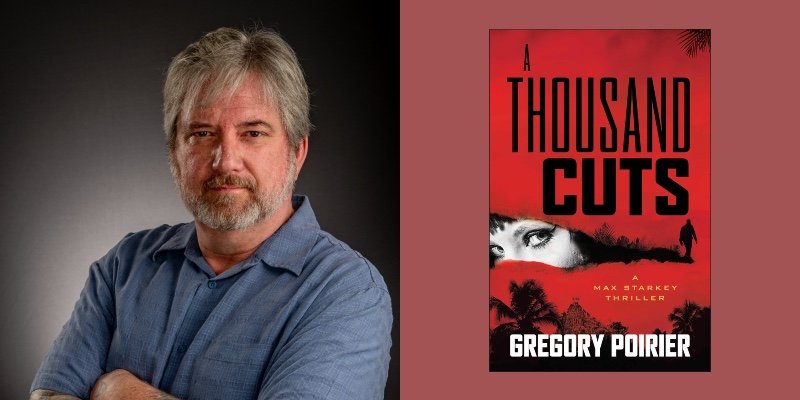
I have been writing movies for a long time and, to paraphrase Paul Mazursky, this awful business has been pretty good to me. My first Hollywood writing job was in 1990, and I have been fortunate enough to earn my living at the keyboard ever since. My first major studio film hit theaters in 1997 (Rosewood), and my latest just last year (Soul On Fire). So why on earth would I suddenly switch to writing a novel after all this time? The answer is simple, and I’m sure most writers can identify with me on this; I didn’t choose it, it chose me.
Article continues after advertisement
How the Idea Developed
When I am struggling for an idea, I sometimes need to stop pushing myself and find a more creative way to stimulate my brain. I like to build challenges for myself that lead me to something interesting. In the case of A Thousand Cuts, that’s where Turner Classic Movies (TCM) comes in.
I love all movies, but I am particularly fond of film noir. I have seen every movie that Humphrey Bogart, Robert Mitchum and Barbara Stanwyck ever made. One day I was eating lunch and watching Out of the Past (again) when an idea hit me; not a story idea, but a way to challenge myself to come up with one.
I gave myself an assignment; imagine a movie that Bogart or Mitchum would make if they were alive today. In other words, something with modern action and a modern sensibility, but firmly rooted in film noir traditions and with a meaty lead role for an actor, preferably an anti-hero type.
I knew a movie like that would have to have certain parameters. It would require an unmistakably noir-ish set up, involving betrayal, a femme fatale, and a lead character knowingly walking into a fatal situation but unable to stop himself. It would need to involve some kind of a heist, preferably one gone terribly wrong. It would need to be layered with multiple betrayals and have a doomed love story. But most of all it needed to be modern, set in our times, and provide the opportunity for modern action sequences.
Once I accepted the challenge, I started to noodle. I noodled for weeks and went down several dead ends before the answer came to me. There was an idea in the back of my mind that I had never been able to crack, about a dictator that is about to be toppled in a coup and has a bunch of gold he needs to get out of the country before it happens. Once I took that idea and applied it to the parameters I had set for myself, A Thousand Cuts began to take shape. I had found my modern Bogart picture.
Or so I thought.
How It Became a Novel Instead of a Movie
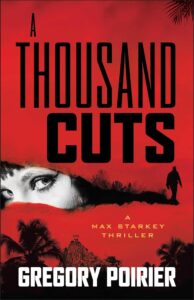
I plotted out my story and started my screenplay. Then I started it again. And again. For whatever reason, the movie I saw so clearly in my head simply wouldn’t appear on the page. The genre wasn’t the problem; I knew I could write a noir since my favorite picture of my career was one, Knox Goes Away (2024). The story was solid, and the set up was undeniably noir; my anti-hero, Max Starkey, an ex-CIA officer working for the mob as a recovery man retrieving stolen money and goods, is pulled into a gold heist in Southeast Asia by the woman who broke his heart, and her husband who happens to be Max’s old rival in the agency. He knows they are going to double cross him eventually, but her pull on him is too strong and he goes anyway. The characters were deep and emotionally driven. Once I had eliminated everything else, I realized it had to be the format itself that was blocking me. The voice that I was trying to create was just not suited to a screenplay. Normally at this point I would drop it and try to find another way to use the dictator’s gold in some other project. But I couldn’t, I wanted to write this movie. It kept me awake at night.
A few days later I was having coffee with a friend, Andrew Marlowe, who wrote Air Force One and created the TV show Castle, and we were lamenting the current state of the movie business (or as we have come to call it, “this f-ing town”), when he said, out of the blue, “I see you transitioning into a successful novelist.” It was something I had never considered, and at the time I laughed it off.
But a few days later, as I was struggling with my screen version once again, I thought, “what can it hurt to try?” So I set the script aside and started to write in a whole new format. It was the first thing I had ever written that didn’t start with the same two words: Fade In.
Within a few pages, I knew I had found my voice. Knox had gotten me close, but it was still a movie and my words were filtered through a director, actors, editors and hundreds of others. In prose I could speak directly to my readers, and put it down exactly the way I heard it in my head. I kept going, and three months later I had an 84,000 word book. Actually, 84,001. For some reason, I like that one.
Why I Chose to Spec the Book Instead of Pitching it
As I wrote the first couple of chapters, I realized that although the voice was working well on the page, it was going to be really hard to explain to someone else. It was something of a hybrid, a wry, 1930s type of narration in a modern world, with big action sequences that I knew would work but which would be kind of hard to summarize (“see, there are all these trucks, and there’s this big hill…”). I’ve been pitching all of my adult life, but in movies you pitch verbally, which gives you the chance to act things out and share your enthusiasm (all screenwriters should take an acting class). I had no idea how to get that same level of excitement across in a written book proposal. Also, I knew how to pitch a story, but I had no idea how to pitch a voice.
And just as importantly, it was flowing. I couldn’t wait to get up every morning and get back to, as my wife puts it, “typing”. Did I really want to put the brakes on and stop the flow to write a book proposal? I was taking a huge chance here, a total career pivot, jumping into a world I knew nothing about with both feet. I figured my reputation as a screenwriter would at least get me some reads, but I also knew the book would have to stand on its own. I was gambling on myself, and ultimately I decided I may as well go all the way.
My friend Andrew has been proven at least half right; I am a novelist now, but whether I will be a successful one remains to be seen. I can only hope that people will read the book and enjoy it. But however it breaks, I got to tell my story, my way, and in the end that’s what counts.