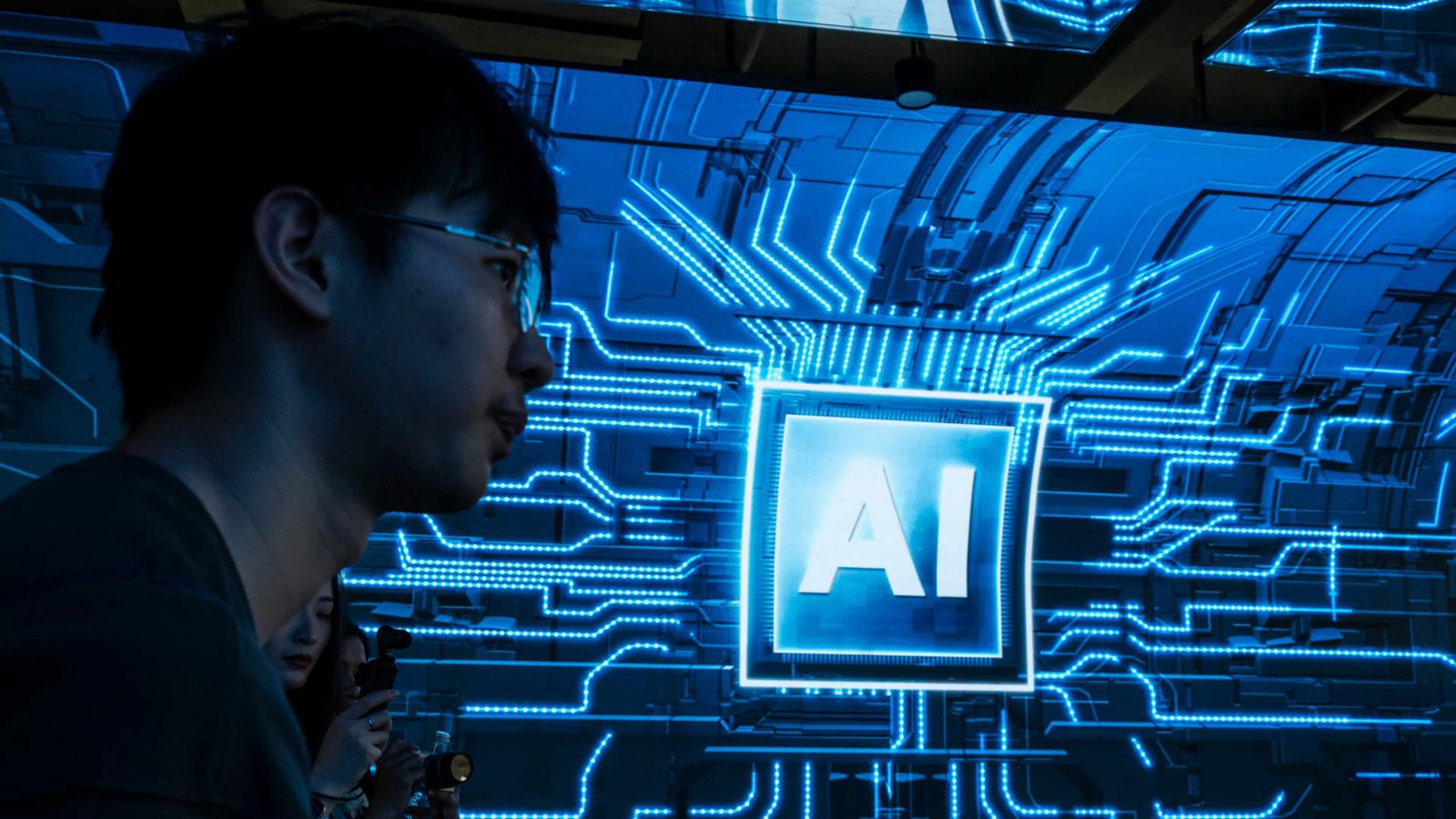
An interactive display featuring artificial intelligence at the iRootech Technology Co. offices in Guangzhou, China, on Wednesday, April 15, 2026.
Bloomberg | Bloomberg | Getty Images
Hi, this is Evelyn, writing to you from Beijing. Welcome to the latest edition of The China Connection — a succinct snapshot of what I’m seeing and hearing from local businesses.
In Hangzhou, startups are taking on both software and hardware as they build devices to run AI. How does this change the AI tech race?
The big story
As Chinese cloud companies rushed to promote OpenClaw in early March, one startup in Hangzhou was already building devices.
EinClaw shipped its first 100 units — of a $43 clip-on mic that lets users send voice commands to an OpenClaw AI agent — on Friday. Just two people developed and assembled the device, from parts sourced across China, co-founder Arvin Chen told me when I visited a WeWork-style office in Hangzhou last week.
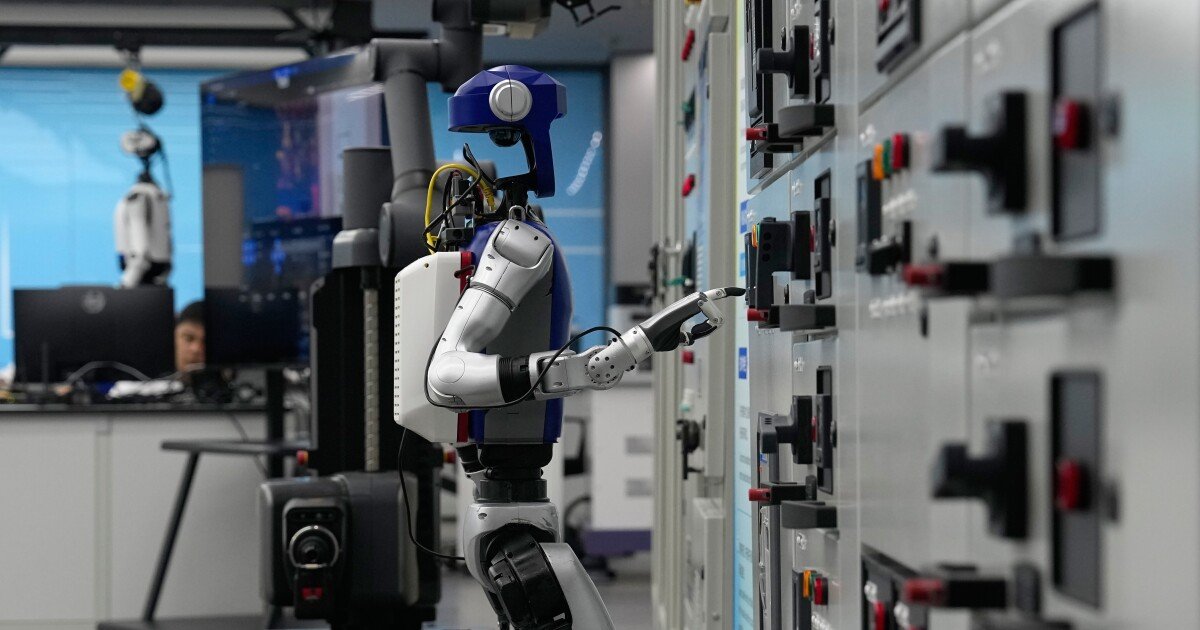
OpenClaw functions are also coming to robots. In nearby Suzhou, startup JoyIn claims its Zeroth M1 humanoid is the first to do so. Using Tencent Cloud tools, people can send commands to the robot and control it remotely, the start-up said. Pre-orders are expected to begin by July.
Together, these point to a shift across industries — from internet-only AI and into hardware.
“Cloud-native is a little bit outdated. The technology is useful, but the business model is a little outdated,” Ray Von, founder, CEO and chairman of Tencent-backed OpenPie, told me last week. “Data sovereignty right now is a concern.”
That’s a big deal, coming from a startup founded to build cloud data systems.
China’s millions of factories illustrate the limits of cloud-only AI. While they’re interested in unlocking AI efficiencies, Von said manufacturers are worried about sending proprietary information to the cloud. So, he said, OpenPie is building devices that enable AI tools to be run locally using low-cost Chinese chips.
The goal is to ship 10,000 of these boxes by the end of this year at 100,000 yuan ($14,627) each, before scaling up, Von said.
Expansion into the physical world is also transforming software-first companies such as Style3D, which got its start in 2015 using AI to help clothing companies speed up the design-to-production process.
So many companies asked Style3D for its data on physical materials and textures that the company decided to enter the business itself — launching robotics platform SynReal last fall, CEO Eric Liu told me Thursday, on the sidelines of a Hangzhou venture capital association conference. He says that to function well in the real world, humanoid robots will need an array of specialized information on textures, to grasp items from oranges to silk scarves — data his company can provide.
Startups aren’t the only ones chasing the hardware trend. Electric car companies, including German automaker Volkswagen, last week announced they are rolling out on-vehicle AI tools to respond to driver voice commands.
Alibaba, which has largely focused on in-app AI tools, this month also revealed that its maps unit, Amap, is developing a four-legged robot.
Again, the company aims to use specialized data from 20 years of digital mapmaking to gain an edge in robotics. Its initial goal is to assist blind people, given the shortage of guide dogs in China.
Map data can assist robot sensors with navigation, while AI tools enable the robot to find nearby convenience stores, for example, based on prompts such as, “I’m thirsty,” said Mu Xu, head of embodied AI algorithms at Amap.
But he warned that, particularly for robotics, the ability to process powerful AI on devices becomes critical — and poses the greatest challenge.
Once that constraint is solved, the question won’t be how capable AI models are theoretically, but what the tech can do once inside every appliance.
Need to know
Foreign car companies bet on technology to hang onto once-lucrative China auto market
U.S., Korean and German automakers rushed to announce a new lineup of models for China around the Beijing auto show that kicked off Friday — using locally developed AI from ByteDance and other Chinese companies.
Economic coercion from U.S. and Europe almost drove Canada ‘into China’s arms,’ says Trudeau
Canadian companies are turning towards making deals with China because of economic coercion from the U.S., former Canadian Prime Minister Justin Trudeau said Thursday at CNBC’s CONVERGE LIVE in Singapore.
Hormuz is just a ‘dry run’ if China and U.S. go to war in the Pacific, Singapore foreign minister warns
Should a war break out between China and the U.S. in the Pacific, “what you are seeing in the Strait of Hormuz will be a dry run,” Singapore Foreign Minister Vivian Balakrishnan said Wednesday at CNBC’s CONVERGE LIVE.
Coming up
April 30: Official Purchasing Managers’ Index for April
May 1: RatingDog China manufacturing PMI for April
May 1: Hong Kong stock market closed for Labor Day holiday
May 1 – 5: Shanghai and Shenzhen stock exchanges closed for Labor Day holiday