
Pat Thompson leads a tour of the EnergyWorks plant in Gettysburg, PA, in 2015 during one of the few times it was operating after construction was completed in 2013. (Dave Harp)
One afternoon in April, Pat Thompson was showing off — again — what it takes to treat 100,000 tons of chicken manure and make most of the nitrogen it contains disappear.
Inside a huge 45-foot-tall building outside Gettysburg, PA, was a large assortment of stainless steel equipment that dries and then super-heats the manure.
In the process, about 80% of the nitrogen is converted to a harmless gas.
The rest, along with the phosphorus, is captured in ash and other byproducts. Steam created from the process drives turbines that produce carbon-free electricity.
Thompson, president of EnergyWorks, the small company that built the facility more than a decade ago, has long envisioned it playing a role in keeping the nitrogen and phosphorus out of the Chesapeake Bay, where the nutrients trigger water-fouling algae blooms.
He has given this tour scores of times since completing construction in 2013, explaining how the technology diverts excess manure from farm fields and turns it into power. Among his guests have been people working to reduce nutrients in the Bay and those with similar problems in Europe, China and elsewhere.
A decade ago, a group visited from the state-federal Chesapeake Bay Program office in Annapolis. They returned enthused about what they had seen, touting the technology as a way to help meet Bay goals.
But the $40 million plant has sat idle for most of the last decade, neither reducing nutrients nor producing power — or generating revenue. Yet Thompson keeps the equipment operational.
His frustration was apparent at the end of the April tour, which included state and federal agricultural officials who, like others, were impressed.
“We have been very patient. It’s costing us a ton of money,” Thompson said. “We can’t continue in limbo for another 20 years.”
There’s no dispute that the facility can remove nitrogen from the manure produced by the 5 million egg-laying chickens at the adjacent Hillandale Farms — the largest concentrated animal feeding operation in Pennsylvania.
But there is debate over how much that would help the Bay.
Thompson insists it would keep millions of pounds of nitrogen a year out of the Bay. But the U.S. Environmental Protection Agency believes only a fraction of that amount likely reaches Chesapeake waters. Others believe the number lies between.
To some, Thompson was overly optimistic by investing in a nutrient control technology, thinking that someone would be willing to pay for those benefits.

The EnergyWorks plant in Pennsylvania removes about 80% of the nitrogen from chicken manure and captures most of the remainder in ash, which can be turned into a fertilizer or other products. (Dave Harp)
Others contend that, without those technologies, the Bay cleanup effort will never reach its goals as the number of farm animals in the region, and the manure they generate, continues to grow.
“To me, this is one of those technologies that, if everything that is promised is true and it can be operationalized, is a game changer,” said Marty Qually, a member of the Board of Commissioners in Adams County, where the plant is located and which has a growing number of poultry farms. “For our county, this is important.”
Hopes for ‘advanced technologies’
Thompson, a former nuclear engineer, started developing the concept for the facility around 2010. At that time, the EPA was developing a “total maximum daily load” for the Bay that would set nutrient reduction requirements for the region.
Pennsylvania, which sends the largest amount of nutrients to the Bay, mostly from its huge number of farms, wanted to promote new technologies to help meet those goals.
It was also developing a nutrient credit trading program so facilities using those technologies could sell credits to other entities struggling to meet the requirements.
In its 2010 Bay cleanup plan, the state envisioned huge regional treatment facilities using “advanced technologies” to treat surplus animal manure.
“We didn’t come up with this out of the blue,” Thompson said. “We responded to Pennsylvania’s efforts to manage their nonpoint source pollution.”
Thompson successfully secured a $15 million loan from PENNVEST, a state financing authority. Another $5 million loan came from the state’s Commonwealth Financing Authority.
He also cobbled together some federal grants and private sector funding, while Hillandale supported other infrastructure for the facility.
When Pennsylvania updated its cleanup plan in 2012, it touted the EnergyWorks plant as an example of progress. Thompson said state officials, including cabinet secretaries, routinely called to check on progress.
Interest in projects that would convert manure to energy was gaining steam around the Bay watershed. The Chesapeake Bay Commission, an advisory panel made up of legislators from states in the region, sponsored a workshop exploring such technologies.
It issued a report in 2012 calling them a “much needed alternative use for excess animal manure” but said that success would require government, academia and the private sector to “think outside the box.”
But many large-scale efforts never became economically viable.
The financial plan behind the EnergyWorks facility never materialized as expected. Thompson had envisioned about 60% of the plant’s revenue coming from the sale of nitrogen credits, with 20% from electricity sales and 20% from sales of byproducts such as fertilizers and other soil amendments.

The chickens produced at Hillandale Farms and by contract growers around Gettysburg, PA, produce about 92,000 tons of manure annually. (Dave Harp)
But the state’s nutrient trading program never developed as anticipated. Wastewater plants, expected to be one of the main buyers, mostly ended up trading amongst themselves.
EnergyWorks launched the plant in 2013, operating occasionally to generate credits for a few contracts, but it never functioned at capacity or for very long. Since 2017, it hasn’t operated at all.
Counting nutrient reductions
In recent years, Thompson has been hoping to sell credits for new “pay for performance” programs designed to help meet Bay nutrient goals in Pennsylvania and to offset impacts of the Conowingo Dam on the Susquehanna River.
But there’s a major impediment. Thompson and the EPA disagree over the level of reductions actually reaching the Bay — and therefore the amount of credits that could be sold.
Thompson believes that most of the 5 million pounds of annual reductions should generate credits. The plant removes 80% of the nitrogen in the manure, turning it into a harmless gas. Most of the rest is captured in ash and in soil amendments that can be more precisely applied to the ground.
The EPA, using computer model estimates, believes the amount of nutrient reductions to the Bay may only be fraction of that.
Right now, the manure produced by Hillandale chickens is applied to tens of thousands of acres of crop land. The reasoning goes that, even if EnergyWorks eliminates nitrogen generated by those chickens, those crops would still need nutrients to grow.
The models use a set of assumptions about the amount of manure and fertilizer available and how they are spread around the watershed to calculate how farms would “backfill” the needed nutrients from other sources.
Because of such assumptions, the computer models used by the EPA estimated several years ago that the Hillandale chickens only added about 200,000 additional pounds of nitrogen to the Bay annually.
Others disagree. Pennsylvania, in its most recent Bay cleanup plan, said those assumptions don’t apply in many parts of the state.
Penn State scientists have also expressed doubt that the manure would be replaced with fertilizer at the rates assumed by the model, in part because fertilizer costs more than manure, which is often free or deeply discounted.
Others have concerns about the data used to drive its estimates. There are questions about the amount of fertilizer available as well as the number of farm animals in the region, all of which drive assumptions about backfilling.

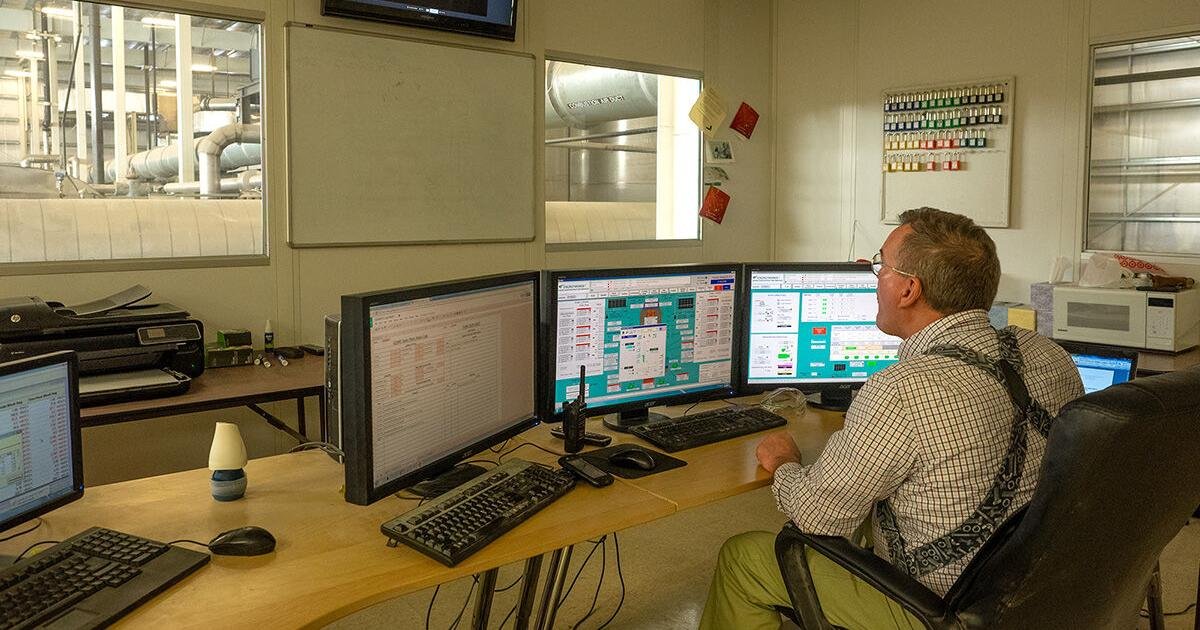
EnergyWorks plant staff in Gettysburg, PA, can treat poultry manure to remove nutrients while generating electricity almost entirely from the control room. (Dave Harp)
In fact, the entire Hillandale operation — along with its more than 5 million chickens and their manure — has never been included in data used for the model.
Zach Easton, a Virginia Tech agricultural engineering professor who chairs the Bay Program’s Agricultural Modeling Team, agrees that crops now getting Hillandale manure would require nutrients from someplace else if the EnergyWorks facility was operating. But, he said, “The magnitude of that backfilling is an open and highly uncertain question.”
Easton said he doubts that EnergyWorks would achieve the level of reductions Thompson claims, but that it likely would achieve more than model figures suggest. “They’re somewhere in between, for sure,” he said.
The only way to know, he said, would be to conduct an experiment to estimate the net reduction, an idea he supports.
Thompson and the Penn State scientists also called for such a study, which state officials proposed in November 2024. Crop acreage that would have received Hillandale poultry manure would have been replaced with other fertilizers, using advanced practices to manage nutrient applications, with the results monitored by Penn State scientists.
For now, that study is on hold, in part because the state is submitting another plan to EPA later this year that would allow for alternate approaches to assess nutrient reductions from manure treatment technologies.
In a statement, the EPA said it supports innovative approaches that protect water quality including Pennsylvania’s efforts to evaluate new manure treatment technologies. But, it said, “any technologies adopted should be grounded in rigorous, gold-standard science, demonstrate real environmental performance, and align with state management plans and Clean Water Act requirements.”
“We look forward to working with Pennsylvania and our partners to advance cost‑effective solutions that deliver measurable results,” it added.
Meanwhile, Thompson remains in limbo.
Addressing the ‘mass balance’
Part of the problem, Easton said, is that the Bay Program’s model emphasizes a “practice-based” approach to nutrient reduction. That means the model estimates nutrient reductions from farms largely based on the use of best management practices, or BMPs, such as nutrient-absorbing cover crops or streamside forest buffers.

Pat Thompson of EnergyWorks hopes processing chicken waste at his facility could allow eggs produced at the adjacent farm to eventually be marketed as an environmentally friendly product. (Dave Harp)
Easton and many others say more emphasis is needed on a “mass balance” approach which puts more emphasis on using manure treatment technologies and other techniques that reduce excess manure in areas with large animal populations. The idea is to bring the amount of nutrients in a region into balance with the amount needed to grow local crops, rather than simply rely on BMPs to control runoff after manure is applied to the land.
Further, the reductions from treatment technologies can be measured while those from BMPs can only be estimated, and their effectiveness is a subject of debate.
“The model is an impediment to trying to address anything from a mass balance perspective,” Easton said.
In their 2024 letter requesting EPA support for the Hillandale experiment, Pennsylvania officials made the same point. They noted that animal populations and the associated manure are increasing while available cropland is decreasing, making a focus on achieving a mass-balance essential.
“While hugely important, traditional [BMPs] alone will likely not produce required nutrient reduction goals in the agricultural sector,” they said.
At the same time, others caution that treatment technologies are not a panacea.
Harry Campbell, a scientist with the Chesapeake Bay Foundation’s Pennsylvania office, cautioned that manure treatment technologies are no “magic bullet.” They generally do not get rid of phosphorus — it is captured in the byproducts — and they do nothing to reduce sediment reaching streams which, according to surveys, is the primary pollutant impacting Pennsylvania’s waterways.
“We support the technologies as a tool in the toolbox, but we have to take a balanced approach,” he said. “You can’t just do manure treatment technology and solve our water quality issues and have sustainable and healthy rivers and streams.”
Campbell said he supports experiments like those proposed for the EnergyWorks project as a way to better understand their actual impacts.
Meanwhile, with that research on hold, Thompson would like to see agencies articulate a path forward so the idled plant can reopen, reduce pollution — and pay the bills. “Right now, it’s money coming out of my pocket every month just to maintain this,” he said.