In 2020, the murder of George Floyd by a Minneapolis police officer ignited protests around the world and a national reckoning over policing.
For Arizona State University Associate Professor Nicole Roberts, it raised an important question: What would happen if officers could see their stress levels rising before conflicts with the public escalate?
Related story
Learn more about Roberts’ work in understanding non-epileptic seizures that can occur in people as a stress response.
And over the past six years, the director of the Emotion, Culture, and Psychophysiology Lab, together with an interdisciplinary group of researchersOther faculty contributors include: Danielle Wallace, Teresa Wu, Scott Barclay and Katina Michael. In addition, former ASU students Tara Paranjpe and Sang-Hun Sim were researchers on the project., has been developing a device designed to do just that.
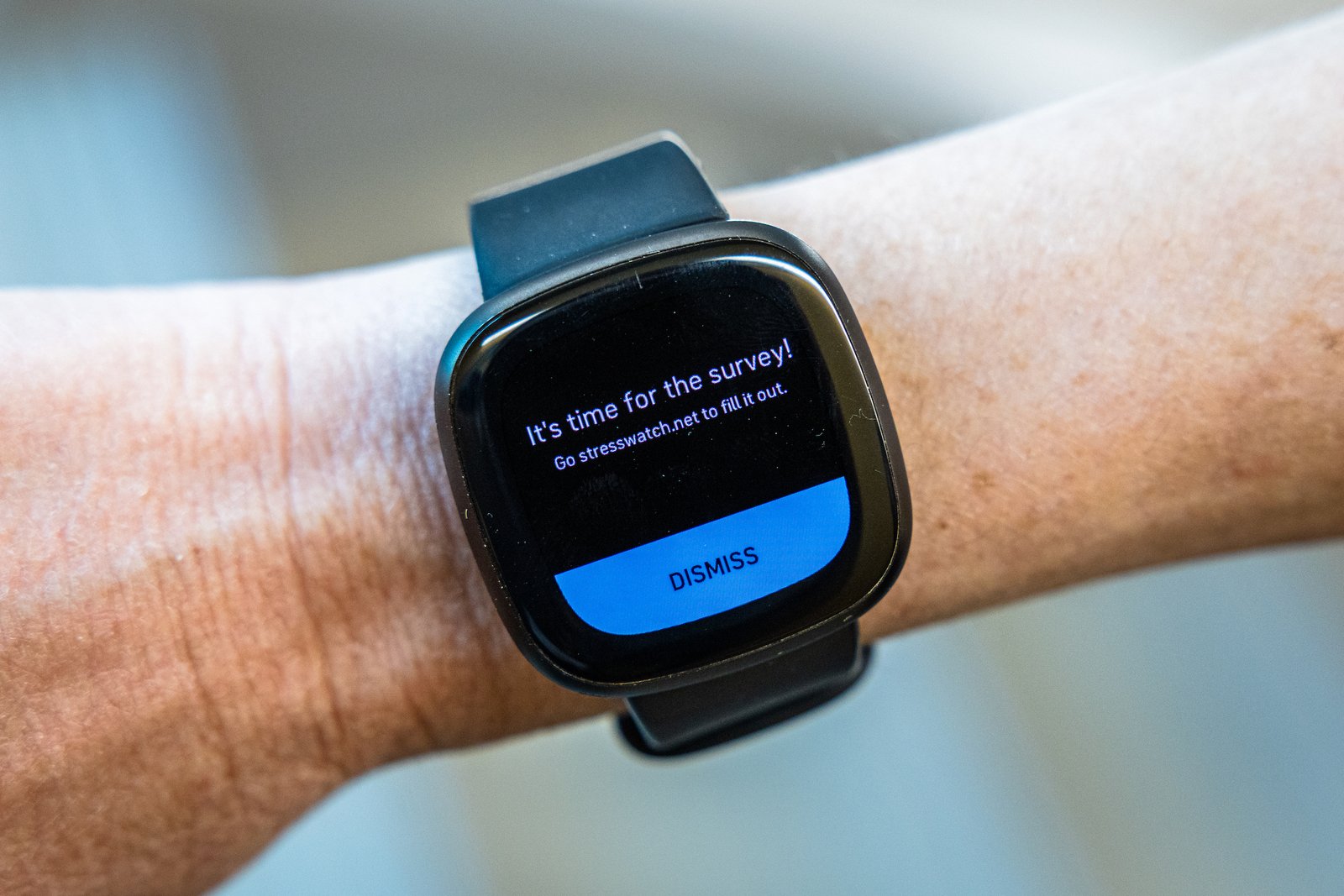
Stress Watch, as the device is cleverly called, uses Fitbit-based technology, machine learning and behavioral science to alert officers when their stress reaches a potentially dangerous level — especially during encounters with the public that can quickly intensify. There is an accountability component to the technology that would notify supervisors or partners as well.
The goal is to prevent stress from compromising decision-making.
“If officers recognize their stress level, then they can change their course of action,” said Roberts, who teaches in ASU’s School of Social and Behavioral Sciences.
“If a friend or a partner told them they were getting worked up, they might not listen. But if they get an alert, perhaps they will be more likely to listen. That was the sort of thinking that led to this.”
Police stress, on and off the job
Roberts has spent years studying how stress affects police officers and their ability to regulate their emotions.
“My interest is in emotion — how you feel feelings and how you regulate those feelings,” she said.
Under stress, that regulation can break down. In high-pressure situations, where officers must make split-second decisions, stress can mean the difference between a routine stop and life-changing repercussions, she said.
“The cumulative stress model would suggest you’re regulating, you’re regulating — and then at some point, you’re not able to do that,” Roberts said.
Stress is not always driven by dramatic moments like high-speed chases, but often by less visible pressures such as bureaucratic demands, family strain, lack of sleep and the inability to calm down after being in a heightened state.
The challenge, she added, is that people often don’t recognize their own rising stress levels.
“Most people can’t see the train wreck before it happens,” she said. “Other people can tell, but the person themselves often can’t.”
In the moment, stress can narrow an officer’s field of vision and limit their ability to consider options, making them more likely to perceive threats and react defensively, she said.
Michael Scott, who spent his entire career in law enforcement roles in places like New York City and Washington, D.C., knows firsthand about the immediate and cumulative stress that comes with a career in law enforcement.
“We have two frameworks for thinking about officer stress,” said Scott, a clinical professor in ASU’s School of Criminology and Criminal Justice and a former police chief. “The most obvious is right in the moment — you jump out of your patrol car and confront someone pointing a gun. Your stress level is going to go all the way to the top in a split second.”
Those intense moments may be brief, he said, but other situations — such as investigating a crime scene — can expose officers to stress for hours at a time.
“Then there’s the long-term cumulative stress that builds up in police officers over years,” Scott said.
“(This) technology has the potential to help officers manage both types of stress — those critical, high-pressure moments and the gradual toll of the job over time,” he said.
Police training academy plays a part
To gather data on how stress unfolds in real-world policing, the ASU research team partnered with the Phoenix Police Regional Training Academy, where cadets wore the devices every hour for 26 weeks during training.
The device captured stress during firearms training, physical conditioning, high-pressure simulations and classroom instruction.
“There were these high-stakes scenarios going on for 26 weeks straight,” said Nicholas Duran, a former ASU scientist who is now a faculty member at the University of Texas at Austin.
Researchers also collected survey data and tracked emotion regulation, sleep, perceived stress, burnout and social factors — such as relationships and support systems — to build a more complete picture of each cadet’s experience.
Duran, a cognitive scientist, was tasked with preparing the data for analysis. The challenge was transforming raw Fitbit data — often noisy, incomplete and inconsistent — into something researchers could study.
“A Fitbit gives you heart rate data that’s pretty crude,” Duran said. “To ask any scientific question, we had to first solve a data quality problem.”
Duran looked at what happens before stress is felt. In some cases, the body showed signs of strain up to 90 minutes before cadets reported feeling stressed.
“What we’re building is more like a smoke detector than a fire alarm,” he said. “A fire alarm goes off when the building is already burning; a smoke detector picks up on the early signs.”
Those early alerts could help officers to pause or reset before stress peaks and affects decision-making.
“That opens the door to earlier intervention,” Duran said. “Not just reacting when stress is already high, but helping prevent it from reaching that point.”
Roberts said the academy setting is especially valuable because it allows officers to build awareness early in their careers and understand how their bodies respond to stress before entering the field.
A personalized approach
ASU computer scientist Ming Zhao led the development of the system’s machine learning framework, which processes data and identifies patterns associated with stress.
“Using real-world data from cadets, we were able to train models to detect stress with high accuracy,” said Zhao, an associate professor in the School of Computing and Augmented Intelligence.
That work helps lay the groundwork for future real-time applications.
The long-term goal is to create personalized interventions — tools tailored to what works for each individual, whether that’s breathing techniques, mental cues or other strategies that help regulate stress.
Potential applications could include real-time alerts to officers, personalized stress-management strategies or even peer support systems that allow partners to recognize when someone may need a moment to reset.
Scott said the team is still in the early stages of development and testing. But with police interactions at a critical juncture, he believes efforts to train newly recruited officers to perform under stress could help address a long-standing challenge in policing.
“I think any police officer, any police supervisor or police administrator, would say, if you’ve got an idea — some way we could tangibly and practically help manage the stress levels of our police officers — we’re interested,” Scott said.
Why this research matters
Research is the invisible hand that powers America’s progress. It unlocks discoveries and creates opportunity. It develops new technologies and new ways of doing things.
Learn more about ASU discoveries that are contributing to changing the world and making America the world’s leading economic power at researchmatters.asu.edu.